


What You Need to Know About MIT Visiting Faculty Opportunities
This comprehensive guide provides an exhaustive overview of the opportunities available for established researchers and post-degree scholars at the Massachusetts Institute of Technology. It delineates the various appointment categories, from Visiting Scholars to specialized fellowships, while detailing the rigorous application processes, financial prerequisites, and visa requirements. By exploring the administrative support systems and the unique research culture of Kendall Square, prospective visitors can effectively prepare for a transformative academic residency within one of the world’s most prestigious intellectual communities.
MIT visiting faculty encompasses several distinct appointment types for external researchers, scholars, and advanced graduate students seeking to collaborate with the Institute’s renowned faculty and access world-class research facilities. Whether you are an established professor on sabbatical, a recent doctorate holder, or a graduate student pursuing dissertation research, MIT offers structured pathways to join its academic community temporarily. The Institute is not merely a collection of buildings but a vibrant, interconnected ecosystem where the boundaries between disciplines are frequently blurred in favor of radical innovation.
Joining this community as a visitor requires a deep understanding of the administrative and academic landscape. The Massachusetts Institute of Technology is famous for its “mens et manus” (mind and hand) philosophy, and this extends to its visiting cohorts. Visitors are expected to be active participants in the intellectual life of their host departments, contributing to seminars, engaging in collaborative labour, and often sharing their expertise with the wider Cambridge academic community.
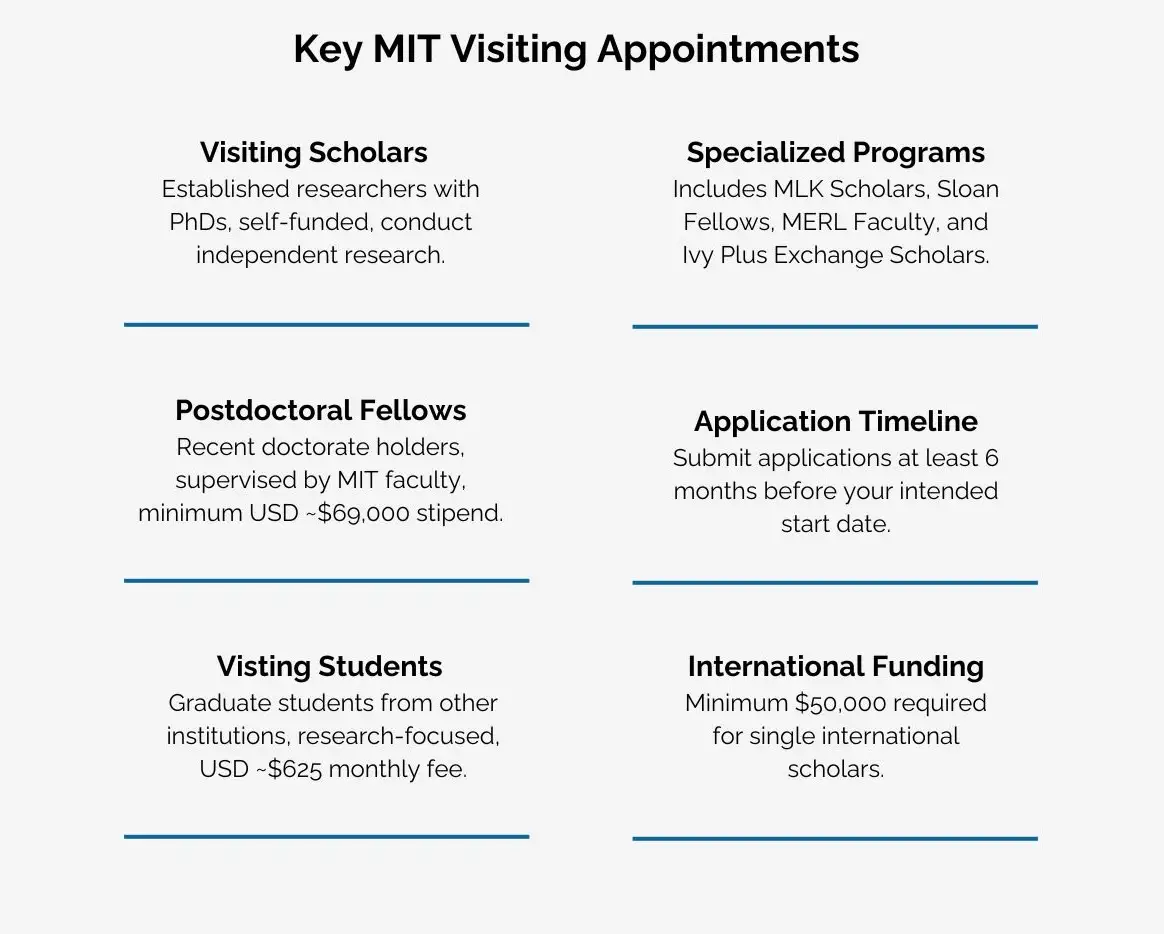
Key MIT Visiting Positions:
- Visiting Scholars – These are established researchers, often holding a PhD or equivalent, who provide their own funding and conduct independent research while affiliated with an MIT department. They are typically on leave from their home institutions.
- Postdoctoral Fellows – Recent doctorate recipients who come to MIT to further their training and develop scholarly competence under the direct supervision of an MIT faculty member. They must receive a minimum stipend, currently set at USD \~$69,000.
- Visiting Students – Graduate students currently enrolled in a degree program at another institution who wish to conduct research at MIT that will contribute towards their home degree. This role requires a USD $625 monthly fee.
- Specialized Programs – These include the MLK Visiting Scholars Program, the MIT Sloan Visiting Fellows, MERL Visiting Faculty, and the Ivy Plus Exchange Scholars, each with its own unique set of criteria and benefits.
Application Timeline: It is imperative to submit your application at least six months before your intended start date. This lead time is necessary for the complex administrative processing involved. For instance, the MIT Sloan Visiting Fellows Program has very specific deadlines, such as April 1, 2026, for the Autumn 2026 semester.
Essential Requirements: The most critical step is securing a faculty sponsor at MIT. Without a host who is willing to advocate for your presence and provide research space, an application cannot proceed. International visitors must also navigate the visa sponsorship process through the International Scholars Office (ISchO) or the International Students Office (ISO). Furthermore, all appointees are required to sign an Invention and Proprietary Information Agreement (IPIA) to protect the intellectual property of the Institute.
Financial Expectations: Funding requirements are stringent and vary by role. Visiting Scholars must be entirely self-funded through external grants or home institution salaries. Postdoctoral Fellows must meet the minimum stipend threshold, which is scheduled to increase to USD \~$71,000 on July 1, 2025. Visiting Students must budget for the $625 monthly fee plus estimated living expenses of USD \~$4,250 for a single person. International visitors must meet specific funding thresholds for visa eligibility, starting at USD \~$50,000 for a single scholar.
As Nadege Conger, founder of SabbaticalHomes.com, I have spent over two decades helping academics navigate the housing challenges that accompany research appointments. Since 2000, SabbaticalHomes has been a trusted resource for academics and scholars seeking affordable, short-term furnished housing options. We recognize that finding a home in the competitive Cambridge and Boston markets is a significant undertaking, and our platform is designed to address the unique needs of “Minds on the Move.”
Articles related to MIT visiting faculty:
- Harvard & BU Postdoc Housing: Your Essential Guide
- Navigating University and Graduate Housing Options
Navigating the Diverse Roles of MIT Visiting Faculty and Scholars
When we think of the Massachusetts Institute of Technology, we often picture the cutting-edge labs of Kendall Square and the historic Great Dome. For those of us in the academic community, the opportunity to join this environment as MIT visiting faculty is a significant career milestone. However, “visiting” at MIT is not a one-size-fits-all label. The Institute maintains a clear hierarchy of Visiting and Affiliate Appointments to ensure every visitor is properly integrated into the research initiatives that match their academic profile.

Eligibility Requirements for MIT visiting faculty
The criteria for these roles are stringent, reflecting MIT’s commitment to academic excellence. For those seeking MIT visiting faculty status, such as Visiting Scholars or Visiting Professors, a PhD or its equivalent is mandatory. These individuals are typically established researchers or faculty members at other degree-granting institutions who come to MIT to pursue independent research or collaborate on specific projects. The distinction between a “Scholar” and a “Professor” often depends on the individual’s rank at their home institution and the nature of their work at MIT.
Postdoctoral Fellows, on the other hand, are generally recent doctorate recipients. They join the community to develop their scholarly competence under the direct supervision of an MIT faculty member. This is a period of intense professional development, often serving as a bridge between doctoral studies and a permanent faculty position. Regardless of the specific title, all appointees must sign an Invention and Proprietary Information Agreement. This legal document is a standard part of the onboarding process, ensuring that intellectual property created during the stay is handled according to Institute policy. This is particularly important at MIT, where the commercialization of research is a common and encouraged outcome.
The Application Timeline for MIT visiting faculty
If there is one piece of advice we can offer from our years of supporting “Minds on the Move,” it is this: start early. MIT recommends at least a six-month lead time for most visiting applications. This window is necessary to coordinate faculty sponsorship, departmental approvals, and, for our international colleagues, visa processing. The administrative machinery of a large university moves with precision, but it cannot be rushed, especially when government agencies are involved in visa issuance.
While many departments review applications on a rolling basis, specific programs have hard deadlines. For example, the MIT Sloan Visiting Fellows program requires applications by April 1, 2026, for the Autumn semester. Your application package will typically require a detailed Statement of Purpose, which should clearly outline your research goals and why they must be pursued at MIT specifically. You will also need a comprehensive Curriculum Vitae, a writing sample (often required by departments like Philosophy), and two to three letters of recommendation from peers who can vouch for your research potential.
Furthermore, the role of the faculty sponsor cannot be overstated. This individual is your primary advocate within the department. They must confirm that they have the space and resources to host you. It is often helpful to have an existing professional relationship with your sponsor, perhaps through conferences or previous collaborations, before making a formal request for sponsorship. This ensures that your research interests are truly aligned with the department’s current trajectory.
Financial Obligations and Funding Expectations
Joining the MIT community requires careful financial planning. The cost of living in Cambridge or Boston is amongst the highest in the United States, and the Institute sets specific funding minimums to ensure visitors can support themselves during their stay. These requirements are not arbitrary; they are based on realistic assessments of housing, food, and transportation costs in the Greater Boston area.
Funding Requirements for International Scholars
For international scholars, meeting the minimum funding levels is a prerequisite for visa sponsorship. As of the current academic cycle, a single international visitor must demonstrate at least USD $50,000 in funding for a year-long stay. If you are bringing a partner or dependents, these requirements increase significantly to account for the added costs of health insurance and larger accommodation. For example:
- Visitor + Partner: USD $60,000
- Visitor + Partner + 1 Child: USD $68,000
- Each additional child: Approximately USD $300–$500 per month
It is important to note that for many categories, no more than 20% of the total funding can come from personal savings; the rest must come from fellowships, grants, or your home institution. These Policies and Procedures §5.5 ensure that scholars have stable, verified financial support throughout their tenure. This policy protects the scholar from financial hardship and ensures that they can focus entirely on their research without the stress of monetary instability.
Costs for Graduate Visiting Students
Visiting Students face a different set of financial structures. All Visiting Students are charged a monthly Visiting Student Fee of USD $625. This fee is not just an administrative charge; it grants access to MIT’s fitness facilities, student life programming, and, crucially, the MIT Student Medical Plan. It also covers the use of the extensive library system and various digital resources that are essential for modern research.
We estimate that a single Visiting Student should budget approximately USD $4,500 per month for all expenses, including housing and the mandatory fee. For married students, this estimate rises to USD $5,500. Faculty hosts often pay a separate processing fee using discretionary funds, but the student is responsible for the monthly portal payments. It is also worth noting that Cambridge has a high “walkability” score, but public transport costs (the “T”) should still be factored into any monthly budget. Many visitors find that the convenience of living near Kendall Square outweighs the higher rent, as it allows for more spontaneous collaboration and networking within the MIT ecosystem.
Administrative Support: ISO, ISchO, and Health Insurance
Navigating the bureaucracy of a major research university can feel daunting, but MIT provides robust support through two primary offices. The MIT International Students Office website (ISO) is the hub for all visiting students, including those who are US citizens. Meanwhile, the International Scholars Office (ISchO) handles the needs of faculty and post-degree researchers. These offices are staffed by experts who understand the nuances of immigration law and university policy.
These offices are essential for visa sponsorship, typically under the J-1 Exchange Visitor status. This visa category is designed to promote educational and cultural exchange. We strongly advise our international members not to book flights or schedule embassy appointments until the ISchO or ISO has officially confirmed that your paperwork is processed. The ‘DS-2019’ form is the crucial document you will need for your visa interview, and it can only be issued once all departmental and financial approvals are in place.
Health Insurance and Medical Coverage
Health coverage is a non-negotiable requirement in the United States. Most visiting students are automatically enrolled in the MIT Student Health Insurance Plan (SHIP), which provides comprehensive coverage through Blue Cross Blue Shield, including preventive care and emergency services. This ensures that students have access to the high-quality care provided by MIT Medical, located right on campus.
For Postdoctoral Fellows, MIT is committed to “cost equalization.” This means the Institute often provides subsidies to ensure that fellows pay no more for their MIT Student Medical Plan than their Postdoctoral Associate counterparts (who are paid directly by MIT). International fellows must ensure their insurance meets the specific J1 health insurance requirements set by the US Department of State, which include specific minimums for medical evacuation and repatriation of remains.
The Role of the DLCI
In MIT parlance, a “DLCI” is a Department, Laboratory, Centre, or Institute. Your primary point of contact will be the DLCI’s human resources administrator or the Director of Finance and Administration (DAF). They work behind the scenes with the ISchO to manage your appointment. They are responsible for verifying your credentials and ensuring that you have the necessary physical access to labs and offices. For a deep dive into these administrative layers, the DLCI Guide to the Visiting Students Program is an invaluable resource for understanding how your host department manages your stay. Understanding the internal structure of your DLCI can help you navigate the social and professional norms of your specific research group.
Specialised Programmes: MLK, Sloan, and MERL
Beyond general departmental visits, MIT hosts several prestigious specialized programs that offer unique opportunities for MIT visiting faculty and researchers. These programs are often highly competitive and provide a more structured experience than a standard visiting appointment.
Engaging with Mitsubishi Electric Research Labs (MERL)
Located just a short walk from the main campus in Cambridge, MERL offers a fascinating hybrid of industrial and academic research. University faculty are invited to spend their sabbaticals at MERL, collaborating on projects ranging from applied physics to artificial intelligence and robotics. This partnership allows for a unique cross-pollination of ideas between the private sector and academia.
The Visiting Faculty Program at MERL is highly collaborative. Unlike some purely academic roles, MERL provides an office, significant compute facilities, and even travel support. Interestingly, applications are considered up to two years in advance, reflecting the long-term nature of their research projects. If you are interested, the first step is to identify a “champion”—a MERL researcher who will help you co-author a proposal for your stay. This ensures that your work will have a direct impact on MERL’s ongoing research initiatives.
The MLK Visiting Scholars and Sloan Fellows
The MIT MLK Visiting Scholars & Professors Program is one of the Institute’s most celebrated initiatives. It honors the legacy of Dr. Martin Luther King Jr. by bringing in a diverse cohort of scholars—ranging from theoretical cosmologists to Pulitzer Prize-winning authors and even innovative artists—to engage with the MIT community. These scholars are expected to contribute to the intellectual life of the campus through public lectures and departmental engagement.
For professionals and alumni, the MIT Sloan Visiting Fellows program offers a non-degree path to study at one of the world’s top business schools. It is a customized course of study that allows you to plug into the Kendall Square ecosystem without the commitment of a full degree. This is particularly popular amongst executives and senior researchers who wish to update their knowledge of management science or entrepreneurship. Similarly, Visiting Scholars at CTL (Centre for Transportation & Logistics) allows researchers to focus on global supply chain innovation, a field where MIT remains a global leader.
The Ivy Plus Exchange Scholar Programme
If you are a doctoral student at a partner institution like Harvard, Princeton, Yale, or the University of Chicago, you may be eligible for the Exchange Scholar Program. This facilitates short-term research exchanges, allowing you to use MIT’s libraries and labs while remaining enrolled at your home university. This programme is an excellent way to access specific equipment or expertise that may not be available at your home institution, further strengthening the ties between these elite research universities.
Frequently Asked Questions about MIT Visiting Appointments
What is the maximum duration for a visiting student appointment?
Visiting student appointments are strictly limited to 12 months. The minimum stay is three weeks. If you need to extend a stay within that 12-month limit, it must be handled through the Visiting Students Process at the ISO well before your initial end date. It is important to note that once the 12-month limit is reached, a student cannot return in the same category for a significant period, as these roles are intended for short-term research collaboration rather than long-term residency.
Can visiting students enroll in MIT classes?
Generally, no. Visiting students are at MIT specifically to conduct research. They are ineligible to enroll in or attend classes for credit. This is the primary difference between a visiting student and a cross-registered student from a local partner like Harvard. However, many visitors find that the informal learning opportunities—such as attending open seminars, guest lectures, and departmental colloquia—are just as valuable as formal coursework. Always check with the individual instructor before sitting in on a lecture to ensure there is sufficient space.
How do I find a faculty sponsor at MIT?
This is the most critical step in the entire process. MIT does not assign sponsors; you must find one whose research aligns with yours. We recommend browsing the Visiting Professor FAQ Page or departmental faculty pages and reaching out with a clear, concise proposal of how your work complements their current research initiatives. Be prepared to explain what you bring to the table—whether it is a specific dataset, a unique methodology, or a fresh theoretical perspective. Persistence and professional networking are key to securing a host.
What kind of library access do visiting scholars receive?
Visiting scholars are typically granted full access to MIT’s extensive library system, which includes millions of print volumes and a vast array of digital journals and databases. Upon arrival and completion of the onboarding process, you will receive an MIT ID card, which serves as your library card and provides access to various buildings on campus. The libraries also offer specialized research consultations, which can be incredibly helpful for visitors who are unfamiliar with the Institute’s specific resources.
Conclusion
Integrating into the MIT academic community is a rigorous but rewarding process. From the high-energy innovation of the Kendall Square ecosystem to the quiet intellectual rigor of the departmental libraries, the benefits of being MIT visiting faculty or a scholar extend far beyond the duration of the appointment. The connections made during a residency at MIT often lead to lifelong collaborations and significantly enhance a scholar’s global academic standing.
At SabbaticalHomes.com, we understand that finding the right place to live is the final piece of the puzzle. Whether you are looking for a quiet study in Cambridge or a family home in Boston, our community of “minds on the move” is here to help you find your perfect home away from home. We are proud to state that rentals with house sitting duties are the most prevalent model and a cornerstone of the community since 2000. This model allows for a unique level of trust and mutual benefit between scholars, making the transition to a new city much smoother.
Find Boston Scholar Housing today and start your journey toward the Institute. Since 2000, SabbaticalHomes has been a trusted resource for academics and scholars seeking affordable, short-term furnished housing options, leveraging expertise to address the unique challenges of finding reliable accommodation in world-class academic hubs.
Let us know what you think! Connect with us on X, LinkedIn, Facebook, Instagram, YouTube and Pinterest.