


Why Housing in Paris Matters for Your Academic Success
Summary: Finding suitable graduate student housing Paris requires understanding the options available to advanced scholars. This guide explains eligibility, costs, and strategies for securing accommodation in Paris. We focus on resources designed for researchers, doctoral students, and post-doctoral fellows to make your search more manageable.
Planning your research stay in Paris involves a significant challenge: finding the right graduate student housing Paris. For doctoral candidates and post-doctoral researchers, suitable accommodation is crucial for academic focus and overall well-being. Paris is a densely populated city where housing demand exceeds supply, presenting unique problems for international scholars.
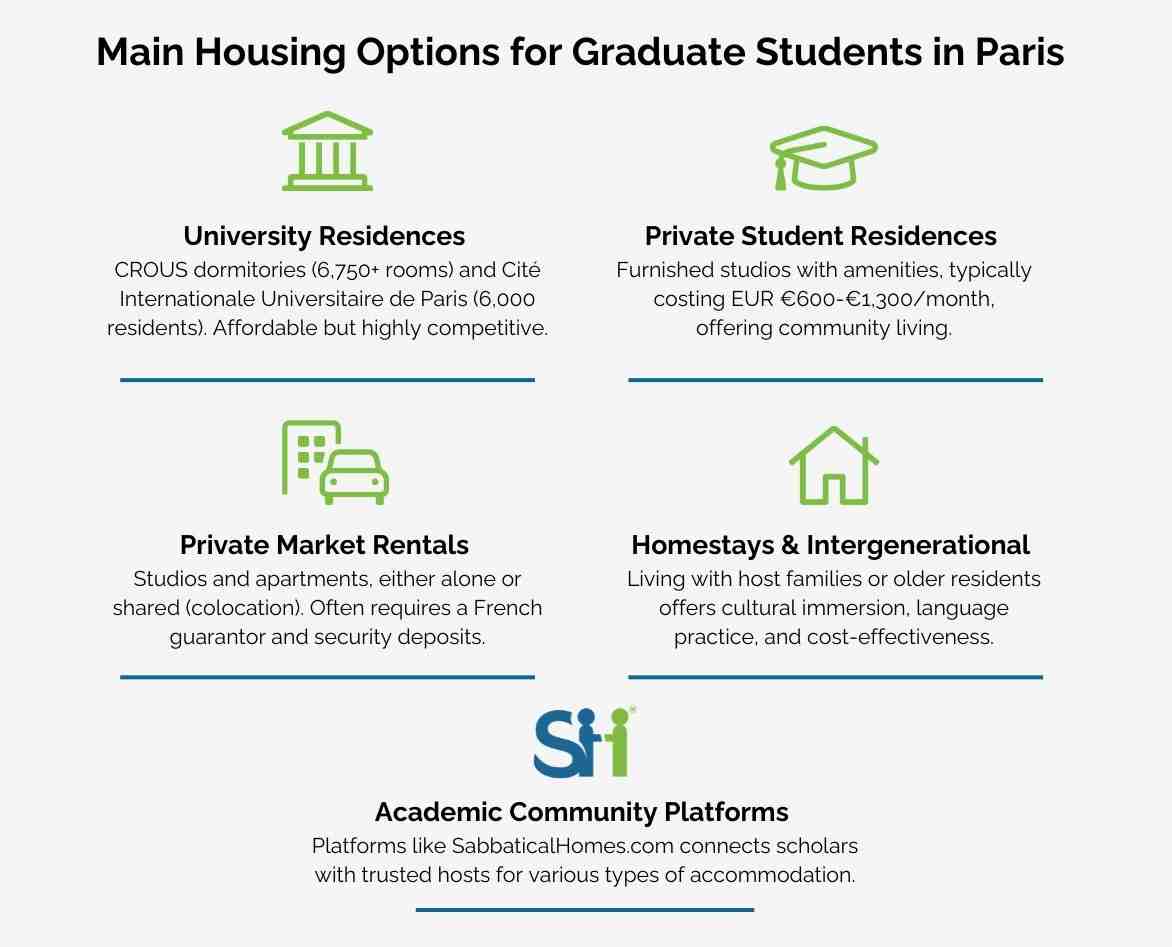
Main housing options for graduate students and post-docs in Paris:
- University Residences – Includes CROUS dormitories and the Cité Internationale Universitaire de Paris (CIUP).
- Private Student Residences – Furnished studios with amenities.
- Private Market Rentals – Studios and apartments, available for individual or shared rental.
- Homestays and Intergenerational Housing – Opportunities for cultural immersion.
- Academic Community Platforms – Services like SabbaticalHomes.com that connect scholars directly.
Since 2000, SabbaticalHomes has been a trusted resource for academics and scholars seeking affordable, short-term furnished housing options, leveraging expertise to address the unique challenges of finding reliable accommodation. Our platform was created to make academic housing searches more manageable through trusted, community-driven connections.
What Are the Main Housing Options for Graduate Students and Post-Docs in Paris?
Unlike undergraduate accommodations, housing for doctoral candidates and post-docs must support focused research and a more independent lifestyle. Paris offers several distinct housing pathways designed for advanced scholars, from affordable university-managed residences to community-focused platforms.
University Residences
University-affiliated housing is the most affordable option, though competition is high. The two main systems are CROUS residences and the Cité internationale universitaire de Paris (CIUP).
CROUS manages thousands of publicly-funded rooms across Paris. It prioritizes grant recipients and exchange students, so eligibility is not automatic for all doctoral candidates. The online application process runs from January to May for the following academic year.
The Cité internationale universitaire de Paris (CIUP) is a unique academic village in the 14th arrondissement, housing nearly 6,000 residents from 150 nationalities. It specifically welcomes master’s students, PhD candidates, and researchers. CIUP offers a vibrant international community with extensive on-site facilities, including libraries and cultural activities. Applications are online, and it is best to apply by April for a September start.
Private Student Residences
For those who don’t secure a spot in university housing, private student residences offer a convenient, albeit more expensive, alternative. These residences provide furnished studios with kitchenettes, private bathrooms, and internet access. Many buildings also feature shared laundry facilities, gyms, and common areas. Rent typically ranges from EUR €600 to EUR €1,300 per month and often includes utilities, simplifying budgeting. The main advantages are modern amenities and the high likelihood of securing a room from abroad.
Homestays and Intergenerational Housing
For scholars seeking deep cultural immersion, homestays and intergenerational housing are excellent choices. A homestay involves renting a private room in a French resident’s home, offering daily language practice and a glimpse into Parisian life. Intergenerational housing connects scholars with older residents who have spare rooms, often for reduced rent in exchange for companionship or light help. Both options provide an affordable and supportive environment, which can be invaluable when adjusting to a new city.
Academic Community Listings: SabbaticalHomes.com
Since 2000, SabbaticalHomes has been a trusted resource for academics seeking furnished housing. We created our platform for the academic community because we understand that researchers need quiet, well-equipped spaces with convenient access to universities. On SabbaticalHomes.com, you connect with fellow academics who are often professors or researchers themselves, creating a foundation of mutual understanding.
Our graduate student housing Paris listings range from studios for solo researchers to larger apartments for scholars with families, all furnished for your convenience. Our platform operates on the core values of community, privacy, respect, diversity, and trust. We are a matching service that empowers you to make arrangements directly with hosts, fostering genuine connections and flexible agreements that suit academic timelines. This approach can also help steer the French rental market’s bureaucratic problems, such as the guarantor requirement.
For more guidance on securing trusted housing abroad, explore our article: How to find the Perfect Academic Housing Abroad
How Can You Navigate the Private Rental Market in Paris?
Many graduate students and post-docs find accommodation in the private rental market, which offers greater independence and flexibility. While navigating it can seem daunting, understanding the basics makes the process much smoother.

Understanding the Private Market
Parisian apartments are typically compact. For temporary academic stays, furnished (meublé) studios or one-bedroom apartments are the most practical choice. Budgeting is key, as rents generally range from EUR €600 to EUR €1,300 per month, depending on the size and the arrondissement (district). Central arrondissements are pricier, while outer ones can offer better value.
Be prepared for the quirks of historic buildings: many lack elevators, have thin walls, and feature small kitchens and no clothes dryers. Always confirm the quality of internet connectivity before signing a lease, as this is crucial for academic work. You can find listings through university housing offices or the CROUS-affiliated service, Lokaviz, which verifies private rentals for students.
Finding a Shared Apartment (Colocation)
Sharing an apartment, or colocation, is a popular way to save money and build social connections. It provides an immediate community, which is especially helpful for international scholars adjusting to a new city. Shared apartments also often offer more living space than a typical studio.
Before committing, clarify the lease structure. A single lease makes all tenants jointly responsible for the rent, while individual leases for each room offer more security. You can find potential roommates through your university’s housing office, student groups, or online platforms dedicated to shared housing. Clear communication about responsibilities and expectations from the start is essential for a harmonious living environment.
Using SabbaticalHomes.com for Private Rentals
SabbaticalHomes.com was designed to meet the specific housing needs of the academic community. Our platform facilitates direct connections between scholars, bypassing many of the frustrations of the conventional rental market.
When you search for Paris rentals on our site, you’ll find listings from fellow academics who understand what researchers need: a quiet workspace, reliable internet, and proximity to campuses. Most listings are furnished, ideal for temporary fellowships or sabbaticals. The flexibility offered on our platform is a key advantage, as you can find housing that matches your specific academic timeline, whether it’s for a few months or a full year.
Our community is built on shared values and mutual understanding. Renting from a fellow academic often leads to smoother, more flexible arrangements that accommodate the demands of research life. For more tips on the rental process, read our guide: Tips for Renting a Home in Paris as a Scholar
What Should You Know About Leases, Guarantors, and Financial Aid in France?
Understanding the administrative side of renting in France is crucial. French rental laws have specific requirements that international scholars must be prepared for.
Decoding French Lease Terms and Vocabulary
Familiarize yourself with these key terms:
Bail(Lease Agreement): The rental contract, typically for one year for furnished properties.Dépôt de garantie(Security Deposit): Usually one month’s rent for furnished housing, refundable after you move out.Garant(Guarantor): A person or entity that agrees to pay your rent if you cannot. This is a standard requirement.Loyer(Rent): The monthly payment.Charges comprises(Utilities Included): Indicates that some utility costs are included in the rent. Always clarify which ones.Préavis(Notice Period): Typically one month for furnished rentals.Assurance habitation(Home Insurance): Mandatory for all tenants.État des lieux(Inventory/Condition Report): A detailed report on the apartment’s condition, vital for getting your deposit back.
Related: 40 Basic French Phrases for Travelers
The Guarantor (Garant) Requirement
The need for a French guarantor is a major hurdle for international scholars. Landlords require one to mitigate the risk of unpaid rent. If you don’t have a family member or friend in France who can act as your guarantor, there are solutions:
- VISALE: A free rental deposit guarantee from the French state. This is an excellent option for scholars who qualify and can be applied for at www.visale.fr.
- University Support: Check with your institution’s international office. Some universities act as guarantors or have partnerships with organizations that provide this service.
- SabbaticalHomes.com: While not a guarantor service, our platform fosters trust within the academic community. Renting from a fellow scholar can sometimes ease the strict guarantor requirement due to shared professional standing.
Financial Aid and Housing Subsidies
France offers housing assistance that can significantly lower your monthly costs. The Caisse d’Allocations Familiales (CAF) provides housing benefits like APL and ALS. Most international students and researchers with modest incomes are eligible.
Be aware that CAF payments can take several months to process, so budget to cover your full rent for the first few months. Other aid includes the Loca-pass Advance, a zero-interest loan for your security deposit from Action Logement, and the A.I.L.E. subsidy from the City of Paris for students. For more financial planning advice, see our article: Budgeting for Your Academic Stay in Paris
What Are Special Considerations for International and Visiting Scholars?
Arriving in Paris from another country presents unique challenges, from navigating administrative systems to securing housing from a distance. With the right preparation, you can manage this process successfully.

Securing Housing from Abroad and Avoiding Scams
Searching for graduate student housing Paris from abroad requires extra vigilance. It is difficult to assess a property’s condition or neighborhood character from photos alone. This is where rental scams can occur. Be wary of landlords who ask for money before you’ve signed a lease or who create pressure to make a quick decision. Always insist on a live video tour.
Using a trusted platform is key. SabbaticalHomes.com provides a secure environment by connecting you with verified members of the academic community. The transparency and shared values within our network significantly reduce the risk of fraud. For more detailed advice, read our guide on How to Avoid Rental Scams When Moving Abroad.
University-Specific Support
Your host university in Paris is a valuable resource. Most institutions have a housing office or international services department dedicated to helping scholars find accommodation. They provide verified listings, guidance on rental procedures, and may have partnerships with housing providers that can simplify your search.
Contact your university’s international office as soon as you are accepted. They can provide custom advice and direct you to trusted resources. These university-specific services understand the local housing market and the needs of their academic community.
Short-Term and Temporary Stays
A smart strategy for international scholars is to book temporary accommodation for your first few weeks in Paris. This allows you to search for a long-term rental in person, without pressure. Furnished short-term rentals or house sitting arrangements are ideal for this.
House sitting can be a perfect match for academics. You live in someone’s home while they are away, often in exchange for caring for the property or pets. This provides a comfortable, fully furnished home at little to no cost.
SabbaticalHomes.com is well-suited for finding these temporary arrangements. Our platform connects scholars with academic homeowners seeking tenants or house sitters. To learn more, visit our pages on house sitting with SabbaticalHomes and Checking References for a Successful Stay.
Related: SabbaticalHomes Member Suzann-Viola Renninger, Columbia University Visiting Scholar
Frequently Asked Questions about Graduate Student Housing in Paris
What is the average monthly cost for graduate student housing in Paris?
The average price for graduate student housing Paris is roughly EUR €600 to EUR €1300 per month. Costs vary based on size, location (arrondissement), and accommodation type. University residences (CROUS) are the most affordable, while private rentals are at the higher end. Remember to budget for additional costs like mandatory home insurance, utilities, and internet.
How can I rent an apartment in Paris without a French guarantor?
This is a common challenge, but solutions are available. Your best option is VISALE, a free state-backed guarantee that is widely accepted by landlords. You should also check with your university’s international office, as they may offer institutional guarantees or have partnerships to assist scholars. Finally, renting through a trusted community like SabbaticalHomes can help, as the mutual respect between academics can sometimes ease strict requirements.
When is the best time to start looking for graduate or post-doc accommodation in Paris?
Start your search early, as the Parisian housing market is competitive. The peak season is June to September. For university residences like CROUS and CIUP, applications open as early as January for the fall. For the private market, begin your search around April or May. On SabbaticalHomes.com, listings are often posted months in advance, allowing you to secure housing well before your arrival.
Conclusion
Finding the right graduate student housing Paris is a critical step in ensuring a successful academic stay. By understanding your options—from university residences and private rentals to homestays and academic platforms—you can steer the process with confidence. Remember to start your search early, prepare for administrative steps like the guarantor requirement, and leverage the support systems available through your university.
Since 2000, SabbaticalHomes has been dedicated to helping scholars find homes that support their work. Our community is built on a foundation of mutual respect and trust, connecting you with hosts who understand the needs of academic life. This shared culture makes finding a suitable, furnished home in Paris a smoother and more personal experience.
Paris is ready to welcome you into its vibrant intellectual community. With the right preparation, you can find a home that allows you to thrive.
Find your perfect academic home in Paris and begin the next chapter of your academic journey.
Let us know what you think! Connect with us on X, LinkedIn, Facebook, Instagram, YouTube, and Pinterest.