


A home swap for academics offers a sophisticated solution for scholars requiring temporary, furnished accommodation during research leaves or international fellowships. By exchanging residences with peers through SabbaticalHomes, researchers access a global network built on mutual trust and shared professional values. This arrangement significantly reduces travel expenses while providing environments tailored to intellectual productivity, such as private studies and proximity to university archives. Understanding the nuances of these exchanges ensures a seamless transition for academics and their families, fostering global collaboration and scholarly focus.
Why Do Academics Choose Home Swaps for Research and Sabbaticals?
A home swap for academics is a housing arrangement where scholars exchange homes for a specific period, typically without paying rent, to secure furnished accommodation during sabbaticals, research trips, or fellowships. This trusted model has connected thousands of academics worldwide since 2000, offering significant cost savings and authentic local experiences. For the modern researcher, the ability to relocate without the crushing burden of commercial rental prices is not merely a convenience; it is often the deciding factor in whether a research project can proceed.
Quick Overview: Academic Home Swap Essentials
- What it is: Scholars trade homes temporarily, usually furnished, without rent payments between parties.
- Main platform: SabbaticalHomes.com (since 2000, 65+ countries).
- Typical costs: Low annual listing fees; no rent payments.
- How it works: Create listing → Search matches → Video call chemistry check → Finalise written agreement → Exchange homes.
- Key benefits: Massive cost savings, furnished homes with offices, campus proximity, networking opportunities, local immersion.
- Exchange types: Simultaneous swaps, non-simultaneous arrangements, hospitality stays, house sitting with rental duties.
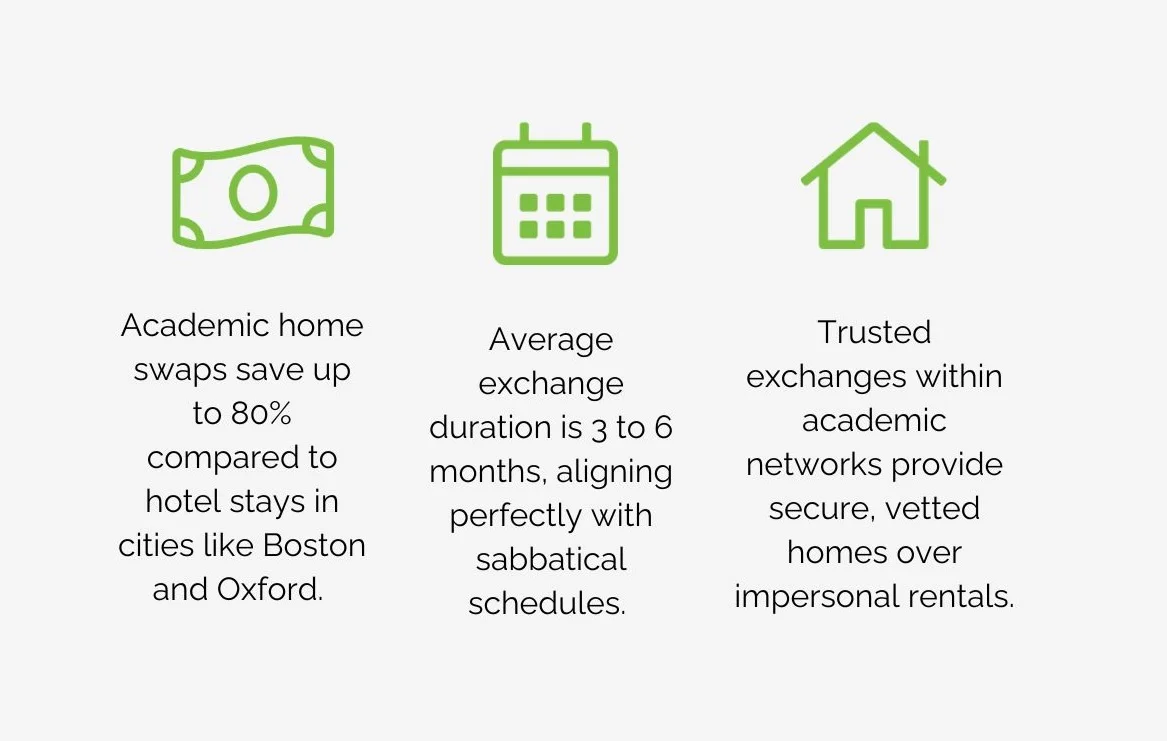
The financial reality is stark. A month-long research trip to London could cost over GBP £5,000 in hotel accommodation alone. Four months in a major academic city is even more cost prohibitive in a hotel. Meanwhile, home exchanges involve only modest platform fees whilst you skip rent entirely. This allows for a more equitable distribution of research grants, ensuring that funds are spent on archives, laboratory equipment, and field work rather than inflated hospitality margins.
But the benefits extend beyond finances. Academic homes typically include dedicated office spaces, proximity to university libraries, high-speed internet, and the kind of quiet, lived-in environment that supports serious scholarly work. You’re not just saving money—you’re gaining a productive workspace and often a network of local colleagues. The psychological comfort of a real home, with a kitchen to prepare healthy meals and a garden to relax in, cannot be overstated for those engaged in the rigorous labour of writing monographs or analyzing complex data sets.
SabbaticalHomes.com was founded in 2000 after witnessing the housing struggles academics face during research trips and sabbaticals. Since then, the platform has facilitated home swap for academics across 65+ countries, connecting over 2 million scholars who’ve discovered that the most reliable housing solutions come from within our own community. This peer-to-peer model bypasses the impersonal nature of corporate housing, replacing it with a system rooted in mutual respect and shared intellectual goals.
Understanding the Concept: What is a Home Swap for Academics?
At its core, a home swap for academics is a symbiotic relationship based on mutual trust. Unlike commercial holiday rentals, these exchanges occur between individuals who share a common professional background and set of values. The concept isn’t new; it originated in the 1950s when teachers and professors pioneered swaps to circumvent the high costs of travel during their summer breaks and sabbaticals. This historical foundation has evolved into a sophisticated global network that prioritizes the specific needs of the higher education workforce.
Today, this tradition continues as a cornerstone of the scholarly experience. We understand that “Minds on the Move” require more than just a bed; they need an environment conducive to deep thought and rigorous research. By choosing a home exchange, you are stepping into a residence designed for the academic lifestyle—complete with bookshelves, quiet study areas, and often a high level of respect for the property that only a fellow researcher can provide. The shared understanding of the importance of a quiet environment for writing and the necessity of reliable internet for accessing digital archives makes these matches uniquely successful.
For a deeper dive into how these arrangements have evolved, you can explore The Professor’s Guide to Home Exchanges.
The Benefits of a Home Swap for Academics During Sabbaticals
The advantages of swapping go far beyond the bank balance. When you exchange homes with a colleague, you gain an immediate “in” to the local academic community. Your host might leave notes about the best archives, introduce you to department heads, or suggest the quietest corner of the university library. This social capital is often more valuable than the financial savings, as it can accelerate the integration process into a new institution.
This level of networking is invaluable. We have seen countless instances where a simple housing match has blossomed into a lifelong research collaboration or an invitation to guest lecture. Furthermore, staying in a residential area rather than a tourist district allows for true local immersion. Whether you are conducting fieldwork in the University of California system or writing a monograph in a quiet London flat, the stability of a real home allows you to maintain your scholarly routine without the disruptions of hotel life. It provides a sense of belonging that is essential for long-term mental well-being during extended periods away from one’s home institution.
Flexible Exchange Models for Scholars
Academic calendars are notoriously complex, and we recognize that a perfect “simultaneous” swap isn’t always possible. To accommodate this, our community utilizes several flexible models that cater to the varying rhythms of the academic year:
- Simultaneous Swaps: You stay in their home while they stay in yours during the same dates. This is the classic model, ideal for summer breaks or synchronized sabbatical leaves.
- Non-Simultaneous Exchanges: You host a colleague during their summer break, and you stay in their home during your winter sabbatical. This requires a high degree of planning but offers maximum flexibility for those with differing term dates.
- Hospitality Stays: You host a scholar in a guest room while you are still in residence. This often leads to stimulating intellectual exchange and is a popular choice for shorter research visits or conference stays.
- House Sitting Duties: In our community, house sitting is frequently integrated into the exchange or rental arrangement. This typically involves light household help—such as tending to a garden, collecting mail, or caring for a beloved pet—in exchange for a reduced rate or as part of a mutual swap. This model ensures that properties are not left vacant and provides peace of mind for both parties.
Related: Long-Term House Sitting Explained
The Economic Advantage: Saving on Global Research Trips
The primary barrier to extended research travel is almost always the cost of accommodation. In major global hubs, the price of a decent hotel or short-term apartment can consume an entire research grant within weeks. By utilising a home swap for academics, you effectively remove the largest line item from your budget. This financial liberation allows scholars to extend their stays, visit additional archives, or bring family members along who might otherwise have been left behind due to cost constraints.
This allows you to reallocate your funds toward research materials, conference fees, or travel to secondary archives. In an era of tightening university budgets and competitive grant funding, such savings are not just beneficial; they are essential for the sustainability of international research.
Avoiding the High Cost of Traditional Rentals
Traditional rentals in cities like London, New York, or Paris are often overpriced and under-equipped for serious work. Many commercial listings lack a proper desk or a quiet environment, being geared instead towards short-term tourists. In contrast, academic homes are “lived-in” and fully furnished with the necessities of scholarly life. They are located in neighborhoods where academics actually live, rather than in transient tourist zones.
Consider the convenience of a kitchen. Eating out in a city like New York for three months is a significant expense; having a full kitchen allows you to maintain your health and your budget. Furthermore, utility arrangements are typically handled with ease between members, often through a simple “you pay yours, I’ll pay mine” agreement or a calculated difference for long-term stays. This is particularly useful when staying near institutions like ETH Hönggerberg, where local housing markets can be incredibly competitive and prohibitively expensive for visiting researchers.
Long-Term Financial Planning for Fellowships
For those embarking on year-long fellowships, the financial implications are even more profound. A fellowship at the Harvard School of Public Health in Boston, for example, requires a stable home base. By arranging a long-term exchange, you ensure that your stipend goes toward your research and family needs rather than a landlord’s profit. This long-term stability is crucial for doctoral candidates and senior faculty alike, providing a secure foundation from which to conduct high-impact research.
How to Navigate a Home Swap for Academics: A Step-by-Step Guide
Arranging an exchange is a journey of discovery. It begins with transparency and ends with a firm handshake (or a digital signature). The process requires a blend of practical organization and interpersonal communication. By following a structured approach, you can ensure that both your home and your host’s home are respected and that the exchange facilitates a productive sabbatical period.
- Create a Detailed Profile: Don’t just list your home; describe your life. Mention your university affiliation, your research interests, and what makes your home a great place for a scholar to live. Highlighting features like a quiet study, a large collection of reference books, or proximity to public transport links to major libraries will make your listing stand out to the right people.
- Use Strategic Search Filters: Look for homes near the specific libraries or departments you need. If you are visiting London, search for proximity to the British Library; if in Paris, look for easy commutes to the Sorbonne. SabbaticalHomes offers filters that allow you to narrow down your search to specific academic hubs, saving you hours of research.
- The Chemistry Check: Before finalizing anything, schedule a video call. This isn’t just about the house; it’s about the person. Discuss your expectations for cleanliness, noise, and communication. This call is an opportunity to build rapport and ensure that your lifestyles are compatible. It is also the perfect time to ask about specific house rules or local neighbourhood quirks.
- Check References: Trust is the currency of our community, but verification is the security. Ask for references from previous exchange partners or colleagues. Most members of SabbaticalHomes are happy to provide these, as it reinforces the community’s standards of mutual respect and reliability.
Creating an Effective Listing for a Home Swap for Academics
To attract the best matches, your listing must speak the language of academia. High-quality, honest photos are essential. We recommend taking photos in natural light that highlight the features most important to a visiting researcher. A well-presented listing not only attracts more enquiries but also sets clear expectations, reducing the likelihood of misunderstandings later on.
- The Workspace: Show the desk, the chair, and the lighting. Is there room for a second monitor? Are there bookshelves available? A dedicated, ergonomic workspace is often the most sought-after feature for a scholar on sabbatical.
- Connectivity: Mention your Wi-Fi speeds. For modern research, this is as vital as running water. If you have a mesh network or a dedicated ethernet port in the study, be sure to mention it.
- Proximity: State clearly how long it takes to walk or take the bus to the nearest campus or major research hub. Use specific landmarks to help your potential partner visualize their daily commute.
- Comforts: Don’t forget the garden or the kitchen. A scholar needs a place to unwind after a long day in the archives. Mentioning a local park or a particularly good nearby coffee shop can also add to the appeal of your home.
Finalising the Agreement and Preparation
Once you’ve found a match, put it in writing using our downloadable customizable PDF. This doesn’t need to be a 50-page legal document, but it should clearly outline the dates, house rules, utility responsibilities, and emergency contacts. Having a written record prevents confusion and provides a reference point for both parties during the exchange. It should also include details on how to handle minor repairs or what to do in the event of a power cut.
We also suggest creating a “House Manual.” This guide should include instructions for the boiler, the alarm system, and even the quirks of the local rubbish collection. Providing local intel—like the best nearby coffee shop for writing or the most reliable mechanic—adds that personal touch that makes a home swap so special. Ensure you have verified your insurance coverage for guests and have a plan in place for any unexpected maintenance issues. A well-prepared host makes for a happy guest, and vice versa.
Related: A Notebook full of Tips for Your Visitors and Guests
Ensuring Security: Trust and Vetting in the Scholarly Community
We take pride in the fact that SabbaticalHomes is a community of “Minds on the Move” who value privacy and respect. Unlike mass-market platforms, our users are generally bound by professional ethics and university affiliations. This creates an inherent layer of security, as members are often part of the same global professional network. The shared commitment to academic integrity translates into a shared commitment to respecting one another’s homes and personal property.
However, we always encourage due diligence. Verifying an academic email address is a simple way to confirm a partner’s identity. Our platform is designed to give you the independence to make your own arrangements, but that independence comes with the responsibility to vet your partners thoroughly. This process of mutual vetting is what keeps the community safe and ensures high-quality matches.
Related: Checking References
Managing Risks and Expectations
Clear communication is the best defence against disappointment. If you have a specific way you like your plants watered or a certain standard of cleanliness, say so upfront. Honesty about the limitations of your home is just as important as highlighting its benefits. If the lift is temperamental or the street can be noisy on Friday nights, it is better that your partner knows this in advance.
- Pets: If the exchange involves pet care, ensure all medical records and food instructions are clear. It is often helpful to introduce the pet to the sitter via video call beforehand.
- Cultural Differences: Be mindful that “quiet hours” or recycling habits vary significantly between London, Berlin, and San Francisco. Providing a brief guide to local customs can help your guest avoid social faux pas.
- Maintenance: Agree on a small fund or a contact person for emergency repairs (like a burst pipe) while you are away. Having a trusted local friend or neighbor with a spare key is essential for peace of mind.
The Role of House Sitting in Academic Exchanges
Since our founding in 2000, house sitting has been a cornerstone of our community. Within the SabbaticalHomes network, rentals with house sitting duties are the most prevalent model and a cornerstone of the community. This arrangement aligns perfectly with our mission of mutual benefit, providing a secure way for homes to be occupied while owners are away on their own research travels.
Whether it’s a Home Rental, a Home Exchange, or a Tenant Listing, house sitting duties—like looking after the cat or keeping the garden tidy—often replace or supplement rent. This model fosters a deeper relationship between the parties; it’s no longer just a transaction, but a favour between colleagues. It allows for a more flexible approach to housing, where the value of the service provided by the house sitter is recognized as a significant contribution to the arrangement.
Maximising Productivity: Why Academic Homes Outperform Traditional Rentals
The most significant “hidden” benefit of a home swap for academics is the boost to your work. A hotel room is designed for sleep and brief stays; an academic home is designed for a life of the mind. The presence of a proper library, a comfortable desk chair, and a quiet atmosphere can significantly increase the output of a researcher during their sabbatical. Furthermore, the absence of the daily distractions found in hotels—such as housekeeping interruptions or noisy corridors—allows for the deep work necessary for complex scholarly projects.
Proximity to Global Research Hubs
Location is everything. Our listings are often situated in the heart of academic districts—places where hotels are either non-existent or prohibitively expensive. Staying in a home near Telecom Paris, Polytechnic Institute of Paris or within walking distance of the Harvard libraries means you save hours of commuting time every week. That’s time that goes back into your writing and research. Being able to walk to an archive or a laboratory allows for a more flexible and productive workday, enabling you to make the most of your limited time abroad.
Family-Friendly Relocation Solutions
For scholars with families, a home swap is often the only viable way to travel. Relocating children to a hotel for four months is a recipe for stress and can negatively impact the productivity of the researcher. A home exchange provides a stable and nurturing environment for the whole family, making the transition to a new country much smoother. This stability is particularly important for postgraduate researchers who may be balancing the demands of a young family with the pressures of completing a doctoral thesis.
- Stability: Separate bedrooms and a garden for children to play in provide a sense of normalcy.
- Kitchen Facilities: The ability to cook healthy meals and maintain a family routine is essential for long-term stays.
- Local Community: Access to information about local schools, parks, and family-friendly activities helps the family integrate quickly.
- Space: Enough room for you to work in one area while the rest of the family lives in another ensures that your research remains a priority without causing domestic friction.
Frequently Asked Questions about Academic Home Swaps
Do swaps have to be simultaneous?
No, they do not. While simultaneous swaps are classic, non-simultaneous exchanges are very common in our community. This flexibility allows you to host a colleague in the summer and use their home during your winter sabbatical. This model is particularly useful for those whose research schedules do not align with standard term dates or for those who wish to visit a location during a specific season for fieldwork.
How do I handle utilities and car exchanges?
Most members agree to continue paying their own utilities at their primary residence to keep things simple. This “wash” approach avoids the need for complex calculations. If there is a significant discrepancy (e.g., one person uses much more heating in a cold climate), a small adjustment can be agreed upon in advance. Car exchanges are also possible and can save a significant amount on rental costs, provided you check your insurance policies and local driving licence requirements beforehand. Always ensure that any car exchange is documented in your written agreement.
What happens if my dates change?
Life in academia is rarely static. If your dates shift due to grant delays or administrative changes, communicate with your exchange partner immediately. Because our community is built on mutual respect and professional understanding, most members are willing to work through schedule changes, provided there is ample notice and honesty. Having a contingency plan or a flexible mindset is key to a successful exchange.
Are these exchanges suitable for doctoral researchers?
Absolutely. While senior faculty often use the platform, doctoral candidates and postgraduate researchers find home swaps to be an essential tool for managing the costs of international research. The ability to live affordably in a high-cost city can be the difference between completing a crucial chapter of a thesis and having to cut a research trip short. The community welcomes scholars at all stages of their careers, provided they adhere to the principles of mutual respect and professional conduct.
Conclusion
Since 2000, SabbaticalHomes has been a trusted resource for academics and scholars seeking affordable, short-term furnished housing options, leveraging expertise to address the unique challenges of finding reliable accommodation. We are more than just a directory; we are a global neighborhood for “Minds on the Move.” By facilitating these connections, we help to sustain the global exchange of ideas and the advancement of knowledge across borders.
By choosing a home exchange, you are embracing a tradition of trust and collaboration that has supported the higher education workforce for decades. Whether you are heading to Oxford, Toronto, or Sydney, your next great research breakthrough could start with the simple act of swapping keys. The relationships formed through these exchanges often last far beyond the sabbatical itself, enriching both your professional and personal life.
Ready to see where your research could take you? Find your next academic home rental or exchange and join a community that truly understands your journey.
Let us know what you think! Connect with us on X, LinkedIn, Facebook, Instagram, YouTube and Pinterest.