


Quick Guide to Short-Term Rentals in Toronto
Toronto’s short-term rental market offers academics a wealth of furnished housing options for research trips, sabbaticals, and visiting fellowships, but navigating the city’s regulations is essential. This guide explains Toronto’s rental requirements, tax obligations, and how to find compliant, academic-friendly accommodations. Whether you’re a visiting scholar or hosting one, understanding these rules ensures a smooth, productive stay in Canada’s largest city.
Short term rentals in Toronto are accommodations rented for less than 28 consecutive days in exchange for payment. Here’s what you need to know:
For Guests:
- Verify the listing has a City of Toronto registration number (format: STR-0000-XXXXXX)
- Expect to pay an 8.5% Municipal Accommodation Tax (MAT) on stays under 28 days (effective June 2025-July 2026)
- Ensure the rental is the host’s principal residence
- Check that the listing appears on Toronto’s Open Data portal
For Hosts:
- Only your principal residence can be rented short-term
- Registration with the City of Toronto is mandatory (CAD $50 annually)
- Entire-home rentals are limited to 180 nights per year
- You must collect and remit the Municipal Accommodation Tax
What’s Excluded:
- Hotels and motels
- Student residences operated by educational institutions
- Stays of 28 days or longer (considered long-term rentals)
Toronto has become a magnet for academics worldwide. With world-class universities like the University of Toronto, York University, and Toronto Metropolitan University, the city attracts thousands of visiting scholars, researchers, and fellows each year. In 2017 alone, Toronto welcomed 43 million tourists who spent nearly $9 billion—a testament to the city’s vibrant appeal.
For academics, finding the right temporary housing can make or break a research trip or sabbatical. A furnished rental near campus with a dedicated workspace, high-speed internet, and a quiet environment isn’t just convenient—it’s essential for productivity. But Toronto’s rental landscape comes with specific rules and regulations that both hosts and guests need to understand.
The regulatory landscape matters. Toronto’s short-term rental bylaws require all operators to register with the city, display their registration number prominently, and collect municipal taxes. Only principal residences can be rented short-term, and entire-home rentals face a 180-night annual cap. These rules aim to preserve housing stock for long-term residents while still allowing homeowners to share their spaces with visitors.
Understanding the costs is equally important. The Municipal Accommodation Tax (MAT) currently sits at 6%, but will temporarily increase to 8.5% from June 1, 2025, to July 31, 2026. This tax applies to all stays under 28 consecutive days. While many online rental platforms collect this tax automatically, it’s crucial to verify it’s being handled correctly.
Finding the right neighborhood matters too. Toronto’s diverse communities—from the bohemian charm of Kensington Market to the neat tree-lined streets of the Annex—offer distinct living experiences. For academics, proximity to university libraries, research facilities, and public transit can transform a good stay into a great one.
Since 2000, SabbaticalHomes has been a trusted resource for academics and scholars seeking affordable, short-term furnished housing options, leveraging expertise to address the unique challenges of finding reliable accommodation.
What to Know Before You Book: Toronto’s Short-Term Rental Landscape
When considering short term rentals in Toronto, it’s crucial to first understand what the city defines as a “short-term rental.” In Toronto, a short-term rental is any part of a dwelling unit rented out for less than 28 consecutive days in exchange for payment. This definition is quite clear and helps distinguish it from traditional long-term leases.
However, not all temporary accommodations fall under this umbrella. The City of Toronto specifically excludes certain types of properties from its short-term rental regulations. These exclusions typically include hotels, motels, and student residences that are owned or operated by publicly funded or non-profit educational institutions. Additionally, any accommodation provided without payment is also not considered a short-term rental under these bylaws.
Understanding these distinctions is particularly important for academics who might be weighing their options between various types of temporary housing.
| Feature | Short-Term Rentals (Toronto) | Traditional Long-Term Rentals (Toronto) |
|---|---|---|
| Lease Terms | Less than 28 consecutive days | 28 consecutive days or more (typically 12-month leases) |
| Furnishings | Almost always fully furnished, move-in ready | Often unfurnished, requiring tenants to provide their own furniture |
| Flexibility | High flexibility, suitable for brief stays | Lower flexibility, often with penalties for early termination |
| Cost | Higher nightly/weekly rates, includes utilities/amenities | Lower monthly rates, utilities often extra |
| Regulations | Governed by specific city bylaws (registration, MAT) | Governed by Residential Tenancies Act, standard landlord-tenant laws |
For academic stays, short term rentals in Toronto offer significant benefits. Furnished rentals, in particular, provide a seamless experience for scholars and researchers. Imagine arriving in Toronto, perhaps after a long journey, and walking into a home that’s already equipped with everything you need—from a fully functional kitchen to comfortable living spaces and internet access. This convenience allows you to immediately focus on your research or teaching, rather than the logistics of setting up a temporary home.
Why Choose a Furnished Rental for Your Sabbatical or Research Visit?
We understand that academics often have unique needs when relocating for a sabbatical, research trip, or visiting professorship. This is precisely where furnished short term rentals in Toronto truly shine.
Firstly, they are incredibly move-in ready. There’s no need to worry about purchasing furniture, setting up utilities, or even buying basic kitchenware. Everything is typically provided, allowing for a smooth transition into your new temporary life in Toronto. This convenience is a huge time-saver, freeing you up to dive into your work from day one.
Secondly, furnished rentals can be surprisingly cost-effective compared to hotels. As some of our research indicates, short-term rentals often offer better value than hotels due to lower overheads. You get more space, more amenities, and a more authentic living experience, often for a comparable or even lower price point, especially for longer stays.
Thirdly, the home-like amenities are a game-changer. Imagine having your own kitchen to prepare meals, separate rooms for living and sleeping, and a dedicated living area where you can unwind. This provides a sense of normalcy and comfort that a hotel room simply cannot match, fostering a better work-life balance during your academic stay.
Crucially for scholars, many furnished rentals offer dedicated workspaces. We know how vital a quiet, well-equipped space is for writing, research, and virtual meetings. Many of our listings at SabbaticalHomes.com emphasize spaces with good lighting, comfortable chairs, and reliable high-speed internet—all designed to support your academic productivity.
Don’t just take our word for it. Hear from one of our happy academics: A testimonial from a happy academic in Toronto.
Furnished short term rentals in Toronto are ideal for research trips and academic productivity because they minimize distractions and maximize comfort, allowing you to immerse yourself fully in your scholarly pursuits.
Navigating the Rules: Key Regulations for Short-Term Rentals in Toronto
The City of Toronto has implemented specific bylaws to govern short term rentals in Toronto, primarily to manage their impact on the city’s housing supply and ensure community well-being. These regulations aim to strike a balance: allowing residents to rent out their homes for short periods while preserving other units for long-term rental housing. This helps support the housing needs of permanent residents and maintain the character of Toronto’s diverse neighborhoods.
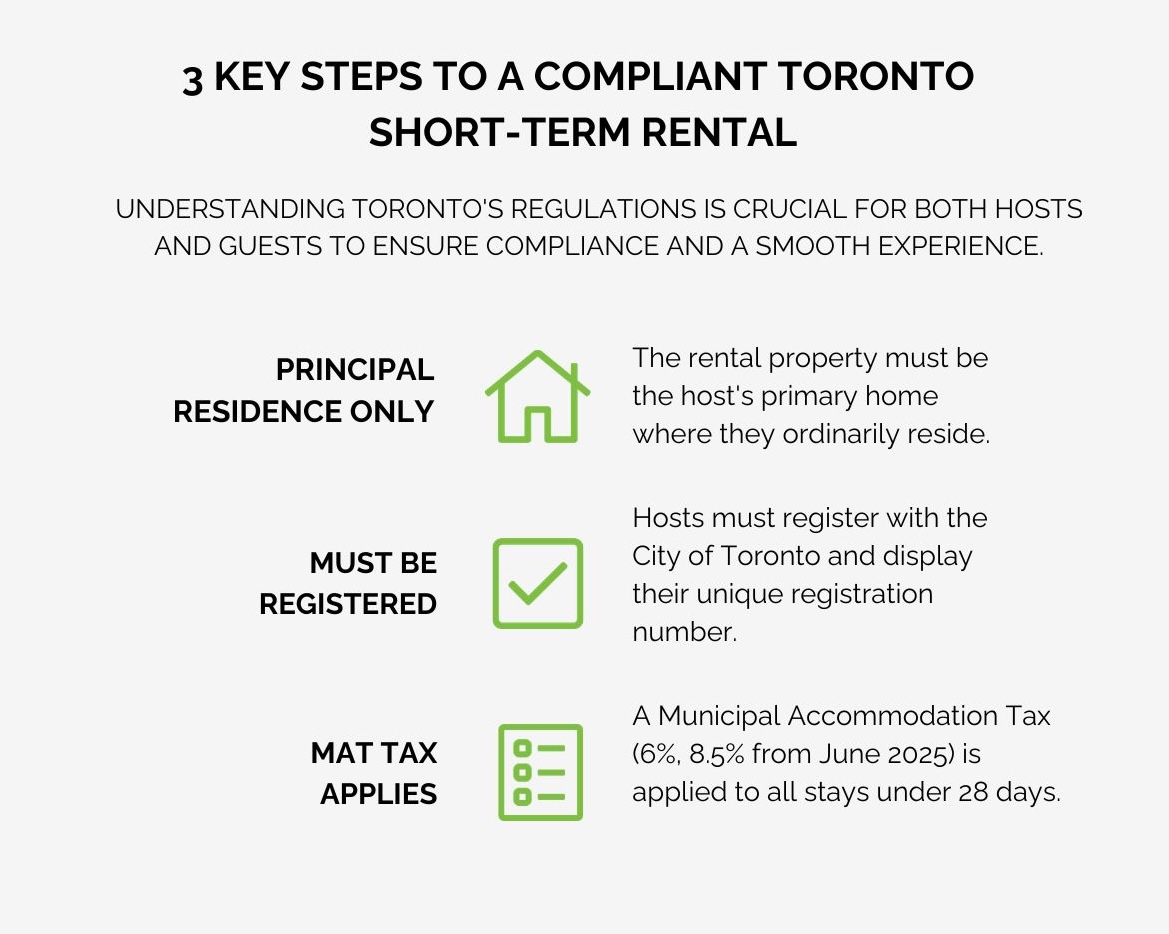
One of the cornerstone regulations is the principal residence rule. This means that short-term rentals are only permitted in a person’s principal residence—the dwelling unit where they ordinarily reside and use for bills, identification, taxes, and insurance. This rule prevents commercial operators from converting multiple units into full-time short-term accommodations, thus protecting the long-term rental market.
Equally important is the registration requirement. All operators of short term rentals in Toronto must register their properties with the City. This ensures accountability and helps the city monitor and enforce its bylaws. We believe transparency is key, and this registration process helps build trust within the community.

Rules for Short-Term Rental Hosts
For anyone considering hosting short term rentals in Toronto, understanding the specific rules is paramount for compliance and a positive experience.
Firstly, the principal residence only rule cannot be stressed enough. Your property must be your primary home. This means if you own multiple properties, only the one you live in primarily can be used for short-term rentals. This is verified during the registration process, often requiring government-issued ID that matches your address.
The registration process itself is mandatory. All short term rentals in Toronto must be registered with the City, and this registration needs to be renewed annually. Once registered, hosts are required to prominently display their registration number on all advertisements and listings. This allows potential guests to verify the legitimacy of the rental and ensures the host is operating legally.
For those renting out their entire home, there’s a 180-night limit per calendar year. This cap helps ensure that homes are not permanently removed from the long-term housing market. If you’re only renting out a private room within your principal residence, this night limit typically does not apply.
Hosts are also expected to maintain meticulous record keeping of all rental nights, prices, and rental types. These records may need to be provided to the City upon request, so keep them organized.
For comprehensive information and to learn more about the registration process, including fees and application steps, we recommend consulting the City’s Official guide for hosts.
Requirements for Rental Platforms
Beyond individual hosts, the City of Toronto also imposes strict requirements on the rental platforms that facilitate short term rentals in Toronto. These platforms, which help connect hosts with guests and process payments, are considered “short-term rental companies” by the City.
A key requirement is the licensing requirement. All such companies must obtain a license to operate within the City of Toronto. This ensures that the platforms themselves are accountable for their role in the short-term rental ecosystem.
Furthermore, these licensed platforms must enter into Data Sharing Agreements (DSAs) with the City. These agreements outline how the platforms will provide data to the City, which is crucial for compliance monitoring and enforcement. This data sharing helps the City ensure that hosts are registered and adhering to the bylaws.
Platforms are also responsible for verifying operator registrations. They must ensure that all listings on their sites have valid City of Toronto registration numbers and are expected to verify these numbers against the City’s Open Data portal. This means if a host doesn’t have a valid registration, the platform should not allow the listing to be active.
Failure to comply with these regulations can lead to significant penalties for non-compliance. The City takes these bylaws seriously, and fines can be substantial, with some violations leading to fines up to CAD $100,000 for companies. This highlights the City’s commitment to regulating the short term rentals in Toronto market effectively.
The Financials: Understanding Taxes and Fees
Beyond the regulatory framework, understanding the financial obligations associated with short term rentals in Toronto is crucial for both hosts and guests. The primary financial component is the Municipal Accommodation Tax (MAT).
The purpose of MAT is to generate revenue for the City of Toronto, which helps fund tourism promotion and development, as well as other municipal services. It’s applied to transient accommodations, meaning short-term stays.
Currently, the current tax rate for MAT on short term rentals in Toronto is 6%. However, it’s important to note a significant upcoming change: there will be a temporary rate increase to 8.5% for stays between June 1, 2025, and July 31, 2026. This temporary increase reflects Bylaw 1259-2024. For anyone planning a stay or considering hosting during this period, this 2.5% increase is a notable factor.
So, who collects it? Typically, the MAT is collected by the short-term rental operator or the platform through which the booking is made. Many larger platforms have Voluntary Collection Agreements with the City, meaning they collect and remit the tax on behalf of their hosts. However, as a host, it remains your responsibility to ensure the tax is collected and remitted correctly, either directly or through your chosen platform.

How the Municipal Accommodation Tax (MAT) Works
Let’s dig a bit deeper into the mechanics of the Municipal Accommodation Tax for short term rentals in Toronto.
The MAT applies to stays under 28 days. If a guest books an accommodation for 28 consecutive days or more, it is generally considered a long-term rental and is exempt from MAT. This distinction is vital for understanding your tax obligations.
For hosts, the MAT is due on a quarterly remittance basis. This means you’ll need to report and pay the collected tax to the City every three months. Even if you had no rentals during a quarter, or if a platform handled the collection, you are still typically required to file a MAT report, indicating zero activity or confirming the platform’s remittance.
As mentioned, some short-term rental companies have Voluntary Collection Agreements with the City. These agreements simplify the process, as the company collects the MAT from guests and remits it directly to the City. However, hosts should still be aware of these transactions and ensure their records align.
Finally, there’s the question of HST applicability. The MAT itself is only subject to HST (Harmonized Sales Tax) if you are registered for HST as a short-term rental operator. Generally, you do not have to register for HST if your income from short term rentals in Toronto is below CAD $30,000. For more detailed guidance, we recommend reviewing the official Information on HST for short-term rentals. It’s always best to consult with a tax professional if you have specific questions about your individual circumstances.
Finding Your Perfect Academic Stay in Toronto
With the regulations and financials clear, the next exciting step is finding your ideal temporary home in this vibrant city. Toronto boasts an incredibly diverse mix of neighborhoods, each offering its own unique charm and advantages. This diversity is a huge plus for academics, as it allows us to match specific needs—whether that’s a quiet retreat for writing or a busy urban hub close to everything.
For academics, proximity to major universities is often a top priority. Toronto is home to several world-renowned institutions, including the University of Toronto, York University, and Toronto Metropolitan University. Many neighborhoods offer convenient access to these campuses, often via excellent public transit access. Toronto has a high Transit Score in many downtown areas, indicating that public transportation is readily available and efficient, making commutes easy even without a car.
Top Neighborhoods for Academic Short-Term Rentals in Toronto
Choosing the right neighborhood can significantly improve your academic experience in Toronto. We’ve identified some top neighborhoods that are particularly well-suited for scholars seeking short term rentals in Toronto:
- The Annex: This historic and leafy neighborhood is practically an extension of the University of Toronto campus. It’s known for its beautiful Victorian homes, independent bookstores, cafes, and a strong intellectual vibe. It offers a quiet, residential feel while being steps away from academic resources.
- Yorkville: Just northeast of the UofT, Yorkville is an upscale district known for its luxury boutiques, art galleries, and fine dining. While more expensive, it offers sophisticated living and is still within easy reach of the university and major cultural institutions like the Royal Ontario Museum.
- Cabbagetown: East of downtown, Cabbagetown is one of Toronto’s most charming historic districts, with beautifully preserved Victorian architecture and tree-lined streets. It offers a quieter, community-oriented atmosphere, ideal for focused work, yet remains well-connected to the city center.
- Little Italy: This vibrant neighborhood along College Street is known for its lively atmosphere, excellent restaurants, and a strong sense of community. It’s a bit further from the main university campuses but offers a rich cultural experience and good transit links.
- Downtown Core: For those who thrive in the heart of the action, the Downtown Core offers unparalleled access to everything Toronto has to offer, from the Financial District to major cultural attractions. While often busier, it provides excellent transit connections to all major universities and institutions.
These neighborhoods, among others, offer excellent access to libraries and research facilities, ensuring that your academic needs are met with ease. For example, if you’re looking for housing near the Leslie Dan Faculty of Pharmacy, University of Toronto, these areas would be prime considerations.
What to Look for in an Academic-Friendly Rental
When selecting your short term rentals in Toronto, we encourage you to prioritize features that directly support your academic work and well-being.
- Dedicated office space: This is often at the top of an academic’s wish list. A separate room, a quiet nook, or even a well-appointed desk area helps establish boundaries between work and rest, crucial for productivity. Look for listings that specifically mention a “laptop-friendly workspace” or a “study.”
- High-speed internet: Reliable, fast internet is non-negotiable for research, online teaching, and staying connected. Always confirm the internet speed and reliability before booking.
- Proximity to campus: An easy commute to your university, research facility, or library saves valuable time and reduces stress. Check transit routes and walking distances to your primary academic destination.
- Quiet environment: For deep focus and writing, a peaceful setting is invaluable. Consider neighborhoods known for their tranquility or look for rentals in buildings with good sound insulation.
- Fully furnished options: As we’ve discussed, fully furnished rentals simplify your move and allow you to settle in immediately. This includes not just furniture but also kitchen essentials, linens, and basic amenities.
At SabbaticalHomes.com, we specialize in connecting scholars with homes that meet these specific needs, understanding that a comfortable and functional living space is integral to a successful academic journey.
Being a Good Neighbour: Responsibilities for Guests and Hosts
Whether you’re a visiting academic enjoying short term rentals in Toronto or a generous host opening your home, we believe in fostering a spirit of mutual respect and community. Our brand values emphasize privacy, respect, diversity, and trust, and these principles extend to how we interact within temporary living situations. Being a good neighbor means upholding certain responsibilities that contribute to a harmonious environment for everyone. This includes following building rules regarding noise, waste disposal, and common area usage, which helps maintain the peace and integrity of Toronto’s residential communities.
Related: Communication Between SabbaticalHomes Members
Key Responsibilities for Guests
As a guest in short term rentals in Toronto, you play a vital role in upholding the community spirit and respecting local regulations. We encourage all our academic travelers to be mindful and responsible during their stay:
- Verifying registration number: Before finalizing your booking, always ensure the listing has a valid City of Toronto registration number. This is a crucial step to confirm you are staying in a compliant rental.
- Respecting property: Treat your temporary home as if it were your own, and respect the belongings of your host.
- Adhering to house rules: Every rental will have specific rules set by the host or building management. These might cover quiet hours, pet policies, or guest limits. Following these rules ensures a pleasant experience for everyone.
- Emergency procedures: Familiarize yourself with the emergency exit plan and the host’s 24-hour emergency contact information, which should be provided and clearly posted in the rental. Know when to call 911 (for emergencies like fire, crime, or medical assistance) versus 311 (for non-emergency issues).
- For a comprehensive overview of what to expect and your responsibilities, we highly recommend reading the City’s official guide: 10 Things You Should Know About Short-Term Rentals.
- Reporting issues to 311: If you encounter a non-emergency issue, such as a concern about a rental operating without registration, excessive noise, or improper waste disposal, you can report it to 311 or submit a complaint online.
Where to Find Official Information
In an increasingly complex digital landscape, it’s more important than ever to rely on accurate and authoritative sources for information. When it comes to short term rentals in Toronto, the City of Toronto’s official channels are your best and most reliable resource.
We strongly advise all hosts and guests to consult the City of Toronto website directly for the most up-to-date bylaws, regulations, and guidelines. Specifically, The official Short-Term Rentals page is an invaluable hub of information, covering everything from definitions and registration processes to tax obligations and complaint procedures.
The importance of using official sources cannot be overstated. Relying on unofficial blogs, forums, or outdated information can lead to misunderstandings, non-compliance, and potential penalties. The City’s website provides clear, concise, and legally binding information that ensures you are fully informed and compliant with Toronto’s short-term rental framework, helping you avoid misinformation and enjoy a hassle-free experience.
Conclusion: SabbaticalHomes—Your Trusted Partner for Academic Stays in Toronto
As we’ve explored, navigating short term rentals in Toronto requires a clear understanding of the city’s specific regulations, tax obligations, and the importance of responsible conduct for both hosts and guests. From the mandatory principal residence rule and registration requirements to the Municipal Accommodation Tax, compliance is key to a smooth and successful stay. We’ve seen how furnished rentals offer a unique advantage for academics, providing comfort, convenience, and dedicated workspaces essential for productive research and sabbaticals.
At SabbaticalHomes.com, we are deeply committed to making the housing challenge easier for the higher education workforce. Our mission is to connect professors, writers, researchers, doctoral and graduate students, post-docs, and university employees with suitable and inspiring temporary homes worldwide. We understand the unique needs of academics—whether it’s an office for writing a book, an easy commute to campus, or a quiet retreat for focused study.
Since 2000, SabbaticalHomes has been a trusted resource for academics and scholars seeking affordable, short-term furnished housing options, leveraging expertise to address the unique challenges of finding reliable accommodation. We pride ourselves on creating a community where hosts find respectful, studious, and trustworthy tenants for their homes, and guests find properties that truly feel like a home away from home. Our platform emphasizes privacy, respect, diversity, and trust, reflecting the values of the academic community we serve.
If you’re planning an academic visit to Toronto or looking to host a visiting scholar, let SabbaticalHomes be your guide. We invite you to Find your ideal home-away-from-home in Toronto and experience the convenience and community that sets us apart.
Let us know what you think! Connect with us on X, LinkedIn, Facebook, Instagram, YouTube, and Pinterest.